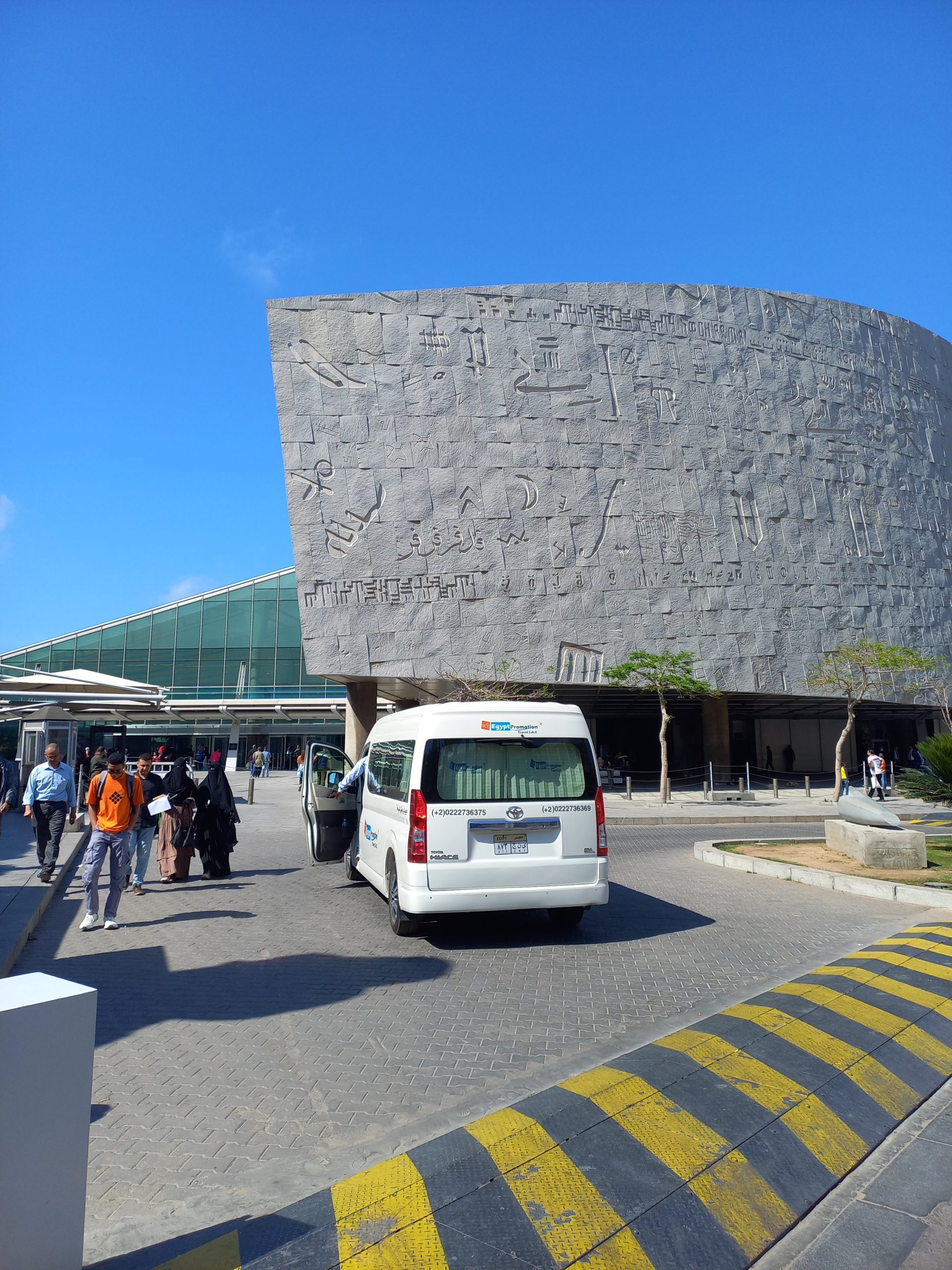
Alexander the Great picked a strip of coast for his new city and left everyone else to work out how it would talk to itself. Priests carved royal decrees three times over, once per script. Christian scribes bolted extra letters onto a borrowed alphabet to catch sounds their own language needed and Greek never had. A caliph’s officials filed paperwork in Arabic while a cathedral kept its own count of names in three scripts side by side. None of these choices ever replaced the Cone before it. Alexandria just added another language on top of the last, century after century, and kept every layer legible at once.
One Decree, Three Scripts
In 196 BC, a council of priests in Memphis cut a decree of thanks to the young pharaoh Ptolemy V into stone. They refused to settle for one version: they carved the text three times, once for each kind of reader who walked the city’s streets.
Priests carved hieroglyphs to speak for the gods, and the temple locked this script away from outsiders. Officials and merchants read Demotic, the cursive form of Egyptian writing, and used it to run the city’s daily business. The court and the administration, heirs to the power of Alexander the Great’s generals, recorded the decree in Greek. Three different readers picked up the same text at once, and none of them could puzzle out the other two scripts.
The stone dropped out of sight near the town of Rosetta, and sand covered it for fifteen centuries. For most of that time, nobody went looking for it. Bouchard found the stone in 1799. His men were rebuilding a fort near Rosetta, and the strange three-part inscription caught his eye. He sent word to the scholars attached to Napoleon’s expedition, and they spent years studying it without result. Champollion picked up the problem next. He worked the three scripts against each other for twenty more years, checking names, matching sounds, and testing guesses against the Coptic language he already knew, until the hieroglyphs finally gave way. Nobody else had managed it. Most scholars in Europe had stopped trying. Translation forces one language to answer for another, and something new comes out the other side.
The Palace and the Street
Alexander the Great picked the site in 331 BC. He wanted a harbor, and the spot delivered on that plan. A fishing village called Rhakotis already stood there, pinched between open sea and a freshwater lake. That lake, Mareotis, put drinking water within easy reach of anyone who settled nearby. The sea did the rest of the work: a ship leaving the harbor could turn toward either half of the Mediterranean without adding days to the voyage. Alexander died before the city took shape. The general who inherited the project was Ptolemy, and he took Egypt’s throne and kept building on the same ground his king had chosen.
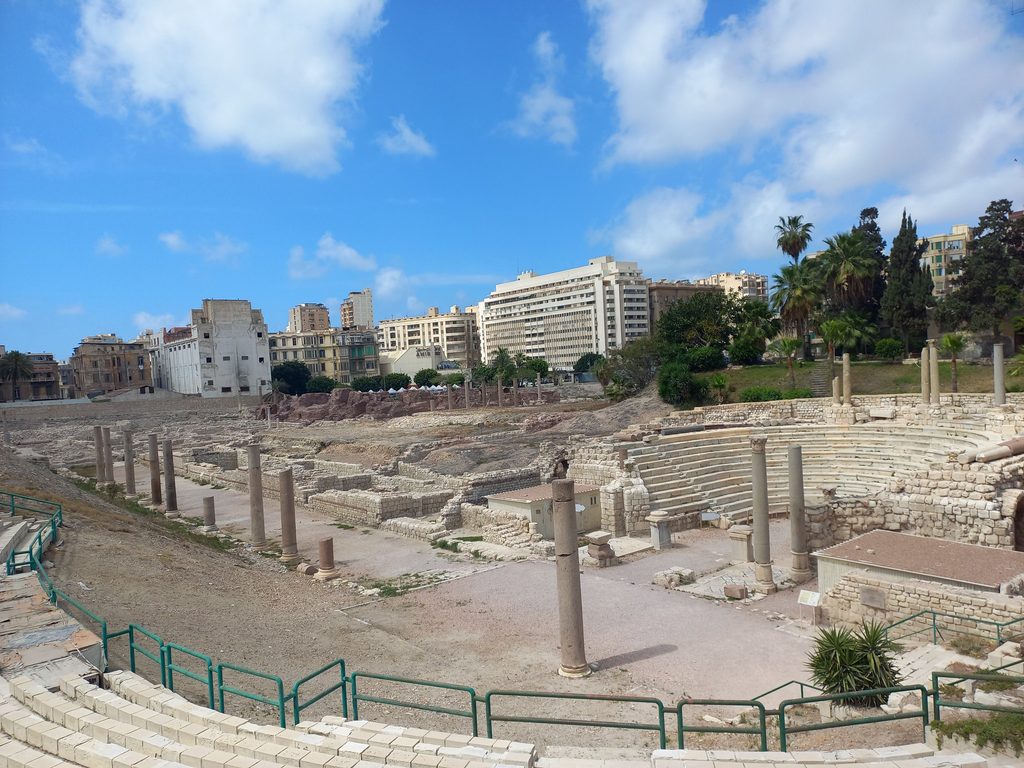
Roman amphitheater excavations in central Alexandria, Kom el-Dikka. Photo by Mike Ivan.
The Ptolemies built something new at court: a research institute called the Mouseion. Scholars converged on it from across the Mediterranean and stayed for years, sometimes for life. Eratosthenes joined them and set out to measure something no one had measured before: the size of the Earth itself. He worked it out from nothing more than shadows and the depth of a well and landed close to the real number. Euclid worked there too, laying down proofs that would outlive him by more than two thousand years and end up in classrooms that still use them. The Library attached to the Mouseion copied scrolls in Greek, and its keepers fitted out ships to chase down texts and pull them off any vessel that docked in Alexandria’s harbor. A text survives only as long as someone keeps copying it into the next generation’s hands.
Beyond the palace walls, the city kept speaking Egyptian. Builders and craftsmen filled the streets, and so did most of the population, and none of them used the language of the court. They read and wrote Demotic instead, a cursive shorthand of the old script. Priests had carved this same script onto that stone in Memphis once before, the one people now call the Rosetta Stone. Greek carried on the business of power: taxes, official correspondence between administrators. Demotic carried the business of the street: the market, the workshop, the daily grind of most people’s lives.
Alexandria never blended the two languages into one. The city split them apart, each confined to its own place, and asked every resident to read the same streets two different ways: through an official’s eyes or through a craftsman’s. Clarity is something every system has to defend, not something it starts with.
Mark Comes to Egypt
Mark reached Alexandria sometime in the middle of the first century and went straight for the city’s Jewish quarter to start preaching. Tradition splits on exactly when he arrived. One strand of it says 49. Another disagrees entirely. That one comes from the Coptic tradition, and it puts the date at 61 instead. Nobody has settled on which is right. By the time the argument started, though, Egypt’s first Christian community had already taken root, and Mark led it as its first bishop.
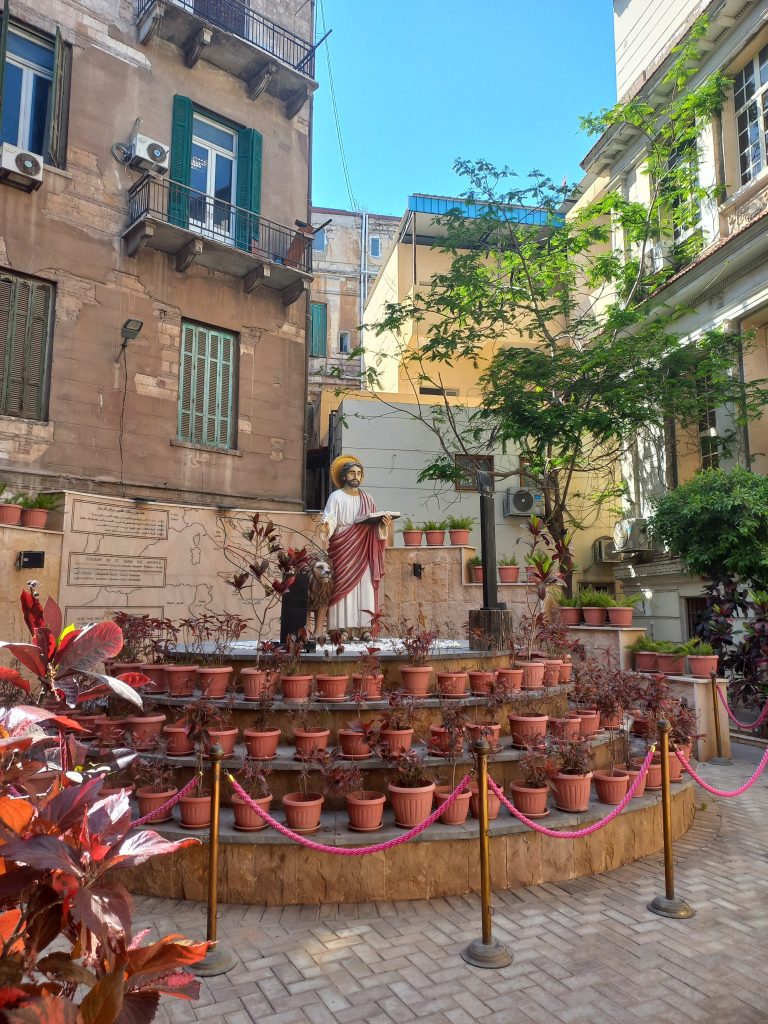
Courtyard of Saint Mark’s Coptic Orthodox Cathedral, Alexandria. Photo by Mike Ivan.
Mark led a service on Easter that year. The city had its own reasons to be out in the streets that same week. Alexandria’s pagans were marking the feast of Serapis at the very same time. The two calendars collided, and the crowd read it as an insult. A mob seized Mark and dragged him by a rope through the streets. They locked him up until morning. He did not survive it. The Coptic Church marks the date as year 68. An earlier source tells it differently. Eusebius of Caesarea, a historian writing closer to the events, put it at 62 or 63.
The community lost Mark, but it did not lose its language. Ordinary Alexandrian Egyptians didn’t talk the way the court wrote. Their speech carried sounds Greek never had: hisses and sounds from deep in the throat. Twenty-four Greek letters could not hold all of it. Scribes found a fix, and they kept it simple. They took the Greek alphabet whole. For the sounds Greek lacked, they reached for a different script entirely. They borrowed Demotic for the gap, the same signs the Memphis priests had once used to carve the Rosetta decree. Count the letters one way and you get six. The manuscripts don’t even agree among themselves. Switch to a different tradition, and the number climbs to seven. Nobody bothered to reconcile the two. Scribes called the result Coptic. Churches kept using it at the altar for centuries after Arabic took over everyday life in Egypt.
641: The Power Changed. The Line Did Not.
General Amr ibn al-As marched his army up to the walls of Alexandria in 641. The city held out. Cyrus ran the negotiations from inside, and he held two jobs at once: Melkite patriarch of the city and Roman prefect of Egypt on top of it. He stretched the talks out for as long as he could, and while he talked, the Byzantine garrison quietly loaded weapons and treasure onto ships bound elsewhere. The city paid its first installment of tribute on December 10, 641. That payment sealed the surrender in principle, but not yet in practice. An armistice stretched the actual handover out for eleven more months. Amr waited. His troops did not march into Alexandria until September 29, 642.
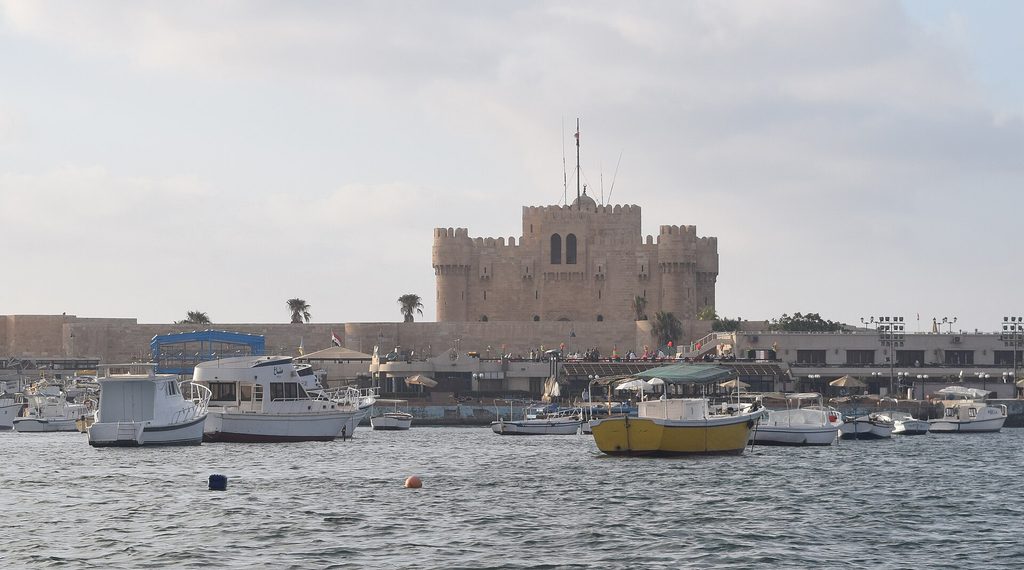
Citadel of Qaitbay, Alexandria. Photo: Wikimedia Commons, CC BY-SA 3.0 / CC BY-SA 4.0.
One man spent the whole siege hiding just beyond the city walls. Cyrus had declared him an outlaw. The man in hiding had a name and a title: Coptic Patriarch Benjamin. He had already spent thirteen years running from Byzantine authorities by the time Amr’s army showed up. The cost of staying free had fallen on his family instead. Byzantine agents caught his brother Mina, tortured him, and drowned him. Any priest they caught met the same fate on the spot. Once Amr controlled the city, he went looking for Benjamin himself. He found him and made a promise: safety and nothing left to fear. Coptic tradition is the source for those exact words. Once Benjamin came out of hiding, the new rulers gave him back the churches and property Cyrus had confiscated. They also let him run the community’s affairs without interference.
The new rulers taxed non-Muslims through jizya, a poll tax Islamic law required. Copts were no strangers to a tax like it. They had paid tribute to Byzantium for generations already. What changed was where the money went, not really how much of it there was: in most places the new jizya matched the old Byzantine rate, and in some places it came in lower. For a community that had spent decades bracing for arrest over its faith, that read as relief, not as punishment.
Greek did not step aside for Arabic right away in the government offices. The changeover took decades, not years. Caliph Abd al-Malik finally made it official. His decree came in the year 81 of the Hijra, close enough to the year 700 on the Christian calendar. That is a long stretch of paperwork written in a language the rulers had already replaced everywhere else. Nearly sixty years had gone by since Alexandria fell. Through every one of those years, the church never missed a beat on one particular count. The line of patriarchs Mark had started six centuries earlier ran on without a single gap.
The Crypt of St. Mark’s Cathedral
A marble plaque marks the entrance to the burial place of the patriarchs inside St. Mark’s Cathedral in Alexandria. Names cover it, one patriarch after another, starting with Mark himself and running through nearly fifty more. Three languages carry the list at once: Coptic, Arabic, and English.
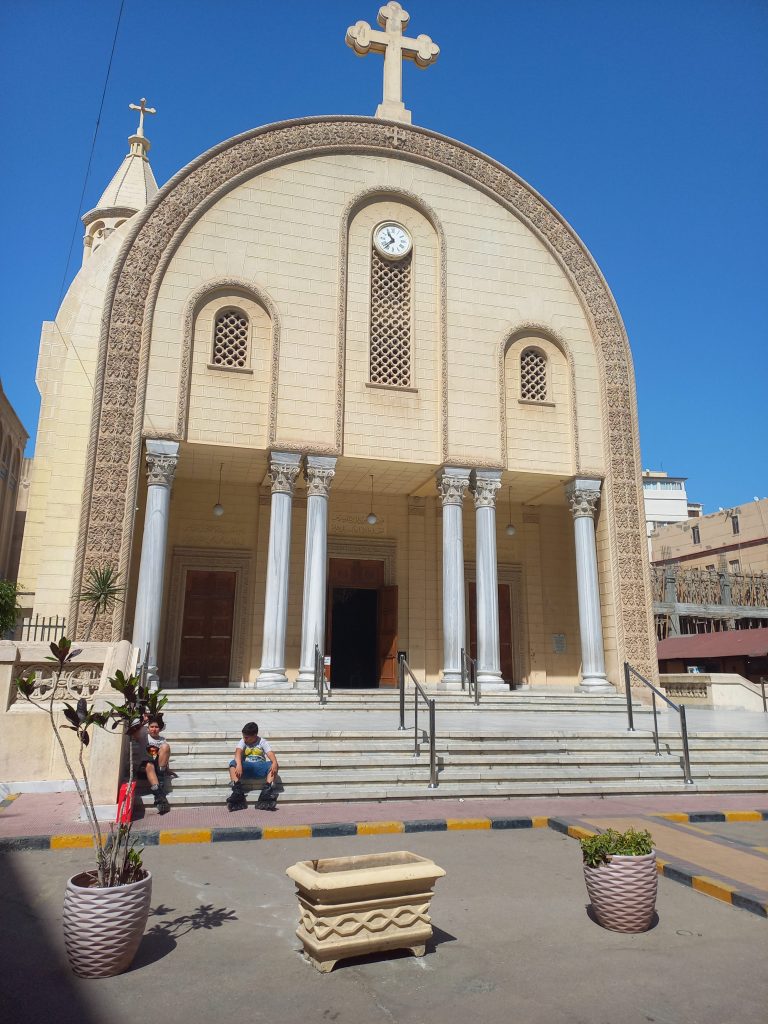
Saint Mark’s Coptic Orthodox Cathedral, Alexandria. Photo by Mike Ivan.
The apostle’s body left this crypt in 828. Two Venetian merchants pulled it off: Buono da Malamocco and Rustico da Torcello. They didn’t work alone. A priest and a monk who served at the tomb helped them, a man named Theodore and another named Stauracius. The two insiders had a warning to pass along. Caliph al-Ma’mun had ordered the church torn down, its stone hauled off for new buildings. Getting the body out of the country took some nerve. The thieves packed it into a basket and buried it under a layer of pork. Muslim customs officers at the harbor wouldn’t touch pork to inspect it, and the basket went through untouched. Back at the tomb, the conspirators left something behind to cover the gap: the remains of another saint, Claudia, swapped in so no one would notice right away. Venice gave the returning body a hero’s welcome. Crowds carried it in procession straight to the doge. Venice folded the apostle into its own coat of arms that day. The winged lion carries his memory now, city and saint together. The Basilica di San Marco holds the relics still, right under the floor. Coptic tradition tells it differently at one point: the merchants carried off the body but left the head behind, and this Alexandria cathedral has kept it ever since. The church marks its recovery every year, on the thirtieth day of the month of Paopi.
The body itself never made the trip back to Alexandria. Centuries passed before anything came back at all, and even then it wasn’t much. Pope Paul VI handed the Coptic delegation a single small fragment of bone on June 22, 1968. The Patriarch of Venice had set that one piece aside specifically for the occasion. Everything else, by the pope’s own account, stayed in Venice. Kyrillos VI sent an envoy in his place to lead the Coptic delegation.
The plaque in the crypt does not ask where its reader comes from.
First Name
The first line on the plaque carries no date. It carries no title either. It holds one word: Mark. Say it in Coptic, and it becomes Markos. Say it in Arabic, and it becomes Marqus. Say it in English, and it barely changes at all: Mark. Three spellings, three alphabets, one name underneath all of them. Every version of it opens the same list of patriarchs. It opens the list because he came first, long before anyone thought to carve a second name beneath his, or a third, or the forty-odd that eventually followed. Some things need three languages before anyone believes them.
Not far from this crypt, near the town of Rosetta, a different stone carried one decree in three scripts, two thousand years earlier. That stone spoke to three different readers of one kingdom, each in a language only they could read. This stone works the other way around. Three scripts, three separate alphabets, converge here to say a single name to everyone who can read any one of them. Below Mark’s name, the plaque runs on for almost fifty more names, one patriarch after another, until it simply stops: the patriarchal seat moved to Cairo, and no one added another line here after that.
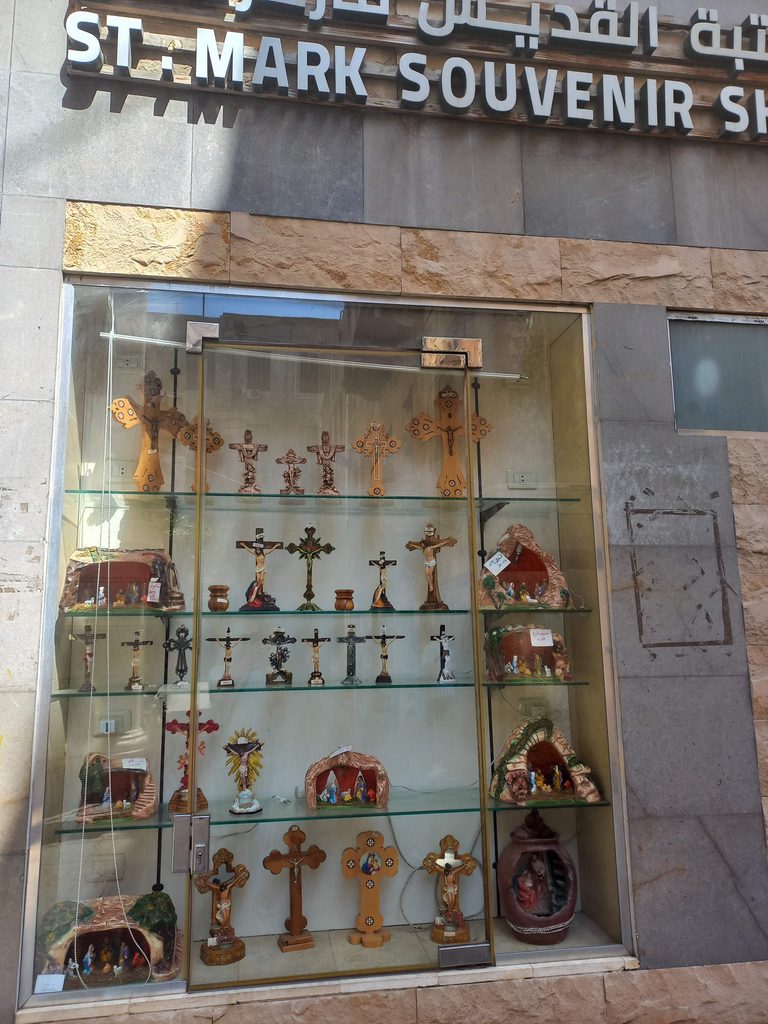
Souvenir shop on the way to Saint Mark’s Coptic Orthodox Cathedral, Alexandria.
Photo by Mike Ivan.
People still come here to read what’s left. A Coptic Egyptian reads the list in the language of the liturgy. An Arab reads it in the language spoken outside these walls. An emigrant’s grandson, raised in Toronto or Melbourne, reads it in English. All three are reading the same names, in the same order, starting from the same first place. The stone preserved the name Mark. Then History recorded it in its annals: St. Mark.
References
- British Museum. “The Rosetta Stone: everything you need to know.” https://www.britishmuseum.org/blog/everything-you-ever-wanted-know-about-rosetta-stone
- Wikipedia. “Rosetta Stone.” https://en.wikipedia.org/wiki/Rosetta_Stone
- Wikipedia. “Jean-François Champollion.” https://en.wikipedia.org/wiki/Jean-François_Champollion
- Wikipedia. “Mark the Evangelist.” https://en.wikipedia.org/wiki/Mark_the_Evangelist
- Wikipedia. “Eusebius.” https://en.wikipedia.org/wiki/Eusebius
- Wikipedia. “Amr ibn al-As.” https://en.wikipedia.org/wiki/Amr_ibn_al-As
- Wikipedia. “Cyrus of Alexandria.” https://en.wikipedia.org/wiki/Cyrus_of_Alexandria
- Wikipedia. “Pope Benjamin I of Alexandria.” https://en.wikipedia.org/wiki/Pope_Benjamin_I_of_Alexandria
- Wikipedia. “Jizya.” https://en.wikipedia.org/wiki/Jizya
- Wikipedia. “Abd al-Malik ibn Marwan.” https://en.wikipedia.org/wiki/Abd_al-Malik_ibn_Marwan
- Wikipedia. “Saint Mark’s Coptic Orthodox Cathedral (Alexandria).” https://en.wikipedia.org/wiki/Saint_Mark%27s_Coptic_Orthodox_Cathedral_(Alexandria)
- Wikipedia. “Saint Mark’s relics.” https://en.wikipedia.org/wiki/Saint_Mark%27s_relics
- Wikipedia. “Pope Paul VI.” https://en.wikipedia.org/wiki/Pope_Paul_VI
- Wikipedia. “Pope Cyril VI of Alexandria.” https://en.wikipedia.org/wiki/Pope_Cyril_VI_of_Alexandria
- TourEgypt.net. “The Cathedrals of Saint Mark in Egypt.” https://www.touregypt.net/featurestories/cathedrals-saint-mark-egypt.htm
- Tripadvisor. “User review, Saint Mark’s Coptic Orthodox Cathedral (Alexandria).” https://www.tripadvisor.com/ShowUserReviews-g295398-d12423300-r519421479-Saint_Mark_s_Coptic_Orthodox_Cathedral-Alexandria_Alexandria_Governorate.html